Disproportionality Analysis
Contemporary drug postmarketing surveillance largely relies on the collection of spontaneous reports of suspected adverse drug events from pharmaceutical companies, healthcare professionals, and patients. These reports are curated and stored in spontaneous reporting systems (SRS), usually organized as a large frequency table for downstream data analysis. We consider an SRS dataset cataloging AE reports on AE rows across drug columns. Let denote the number of reported cases for the -th AE and the -th drug, where and . Therefore, AE-drug pairwise occurrences from the AE-reports are summarized into an contingency table, where the -th cell catalogs the observed count indicating the number of cases involving -th AE and the -th drug.
Current disproportionality analysis mainly focuses on signal detection which seeks to determine whether the observation is substantially greater than the corresponding null baseline . Or equivalently, its signal strength is significantly greater than 1.
In addition to signal detection, Tan et al. (Stat. in Med., 2025) broaden the role of disproportionality to signal strength estimation. The use of the flexible non-parametric empirical Bayes models enables more nuanced empirical Bayes posterior inference (signal strength estimation and uncertainty quantification). This allows researchers to distinguish AE-drug pairs that would appear similar under a binary signal detection framework. For example, the AE-drug pairs with signal strengths of 1.5 and 4.0 could both be significantly greater than 1 and detected as a signal. Such differences in signal strength may have distinct implications in medical and clinical contexts.
Methods implemented in this package assumes the observed count conditional on is that where the parameter is the relative reporting ratio, the signal strength, for the -th pair measuring the ratio of the actual expected count arising due to dependence to the null baseline expected count. Therefore, are our key parameters of interest. A large indicates a strong association between a drug and an AE.
Let be a prior density function for signal strength parameters for all AE-drug pairs: . Then, in the context of the Poisson model, the marginal probability mass function of is given by: where is the probability mass function of a Poisson random variable with mean evaluated at . Under the empirical Bayes framework, the prior distribution is consequently estimated from the data by maximizing the log marginal likelihood: Then, the estimated empirical Bayes posterior density of given is: where .
All empirical Bayes models implemented in ‘pvEBayes’ share the structure described above; they differ by their assumptions on the prior distribution. Implemented methods include the Gamma-Poisson Shrinker (GPS), Koenker-Mizera (KM) method, Efron’s nonparametric empirical Bayes approach, the K-gamma model, and the general-gamma model. The selection of the prior distribution is critical in Bayesian analysis. The GPS model uses a gamma mixture prior by assuming the signal/non-signal structure in SRS data. However, in real-world setting, signal strengths are often heterogeneous and thus follows a multi-modal distribution, making it difficult to assume a parametric prior. Non-parametric empirical Bayes models (KM, Efron, K-gamma and general-gamma) address this challenge by utilizing a flexible prior with a general mixture form and estimating the prior distribution in a data-driven way.
The KM method has an existing implementation in the
REBayes package, but it relies on Mosek, a commercial
convex optimization solver, which may limit accessibility due to
licensing issues. The pvEBayes package provides an
alternative fully open-source implementation of the KM method using
CVXR. Efron’s method also has a general nonparametric
empirical Bayes implementation in the deconvolveR package;
however, that implementation does not support an exposure or offset
parameter in the Poisson model, which corresponds to the expected null
value
.
In pvEBayes, the implementation of Efron’s method is
adapted and modified from deconvolveR to support
in the Poisson model. In addition, this package implements the novel
bi-level Expectation Conditional Maximization (ECM) algorithm proposed
by Tan et al. (2025) for efficient parameter estimation in gamma mixture
prior based models mentioned above.
Package ‘pvEBayes’ provides a suite of streamlined tools for effectively fitting these models to the spontaneous reporting system (SRS) frequency tables, extracting summaries, performing hyperparameter tuning, and generating graphical summaries (eye plots and heatmaps) for signal detection and estimation. In the following we provide an example, borrowed from Tan et al. (arxiv, 2025), of SRS data analyzing with ‘pvEBayes’.
Analyzing FDA statin SRS data with pvEBayes
library(pvEBayes)
library(ggplot2)

set.seed(1)
# load the SRS data
data("statin2025_44")

# show the first 6 rows
head(statin2025_44)
#>                                        Atorvastatin Fluvastatin Lovastatin
#> ACUTE KIDNEY INJURY                            1132          23         23
#> ANURIA                                           46           0          0
#> BLOOD CALCIUM DECREASED                          51           2          0
#> BLOOD CREATINE PHOSPHOKINASE ABNORMAL            19           0          0
#> BLOOD CREATINE PHOSPHOKINASE INCREASED          624          21          4
#> BLOOD CREATININE ABNORMAL                        11           0          0
#>                                        Pravastatin Rosuvastatin Simvastatin
#> ACUTE KIDNEY INJURY                            153         1141         453
#> ANURIA                                           1           56          29
#> BLOOD CALCIUM DECREASED                          3          877           6
#> BLOOD CREATINE PHOSPHOKINASE ABNORMAL            0           11           1
#> BLOOD CREATINE PHOSPHOKINASE INCREASED          41          557         216
#> BLOOD CREATININE ABNORMAL                        0           32           6
#>                                        Other_drugs
#> ACUTE KIDNEY INJURY                         192114
#> ANURIA                                        7079
#> BLOOD CALCIUM DECREASED                      33175
#> BLOOD CREATINE PHOSPHOKINASE ABNORMAL          133
#> BLOOD CREATINE PHOSPHOKINASE INCREASED       17203
#> BLOOD CREATININE ABNORMAL                     2645
Fit the general-gamma model
Our interest lies in finding the most important adverse events and estimating the corresponding signal strength of these 6 statin drugs. These are achieved by fitting empirical Bayes models with pvEBayes() to the SRS data. We begin by fitting the general-gamma model to this dataset. Other models mentioned above could be used by modifying the ‘model’ argument. For illustration, we fit the model with a fixed hyperparameter value of $ = 0.5$ using the pvEBayes() function.
gg_given_alpha <- pvEBayes(statin2025_44,
  model = "general-gamma",
  alpha = 0.5
)
#> ℹ Fitting general-gamma model...
#> ✔ Fitting general-gamma model... [347ms]
#>
#> ℹ Generating 1000 posterior draws...
#> ✔ Generating 1000 posterior draws... [96ms]
#>
#> Object of class 'pvEBayes'
#>
#> General-gamma model with hyperparameter alpha = 0.5.
#> Estimated prior is a mixture of 18 gamma distributions.
#>
#> Running time of the general-gamma model fitting: 0.3557 seconds.
#> Optimizer convergence: successful.
#> Running time for posterior draws
#> (1000 signal strength posterior draws per AE-drug pair):0.1986 seconds.
#>
#> Extract estimated prior parameters, discovered signals
#> and signal strength posterior draws using `summary()`.

gg_given_alpha_detected_signal <- summary(gg_given_alpha,
  return = "detected signal"
)
#> Signal detection result with default threshold parameters is provided. To specify threshold parameter, see 'get_posterior_prob()'.
sum(gg_given_alpha_detected_signal)
#> [1] 107
The return argument specifies which component the summary function
should return. Valid options include: “prior parameters”, “likelihood”,
“detected signal”, and “posterior draws”. If it is set to NULL
(default), all components will be returned in a list. In this example,
we show the detected signals. The ‘summary()’ method reports detected
signals using the default cutoff value and threshold:
Users can customize
signal detection with both the cutoff and the posterior probability
threshold through the ‘get_posterior_prob()’ function. For example, the
code below identifies signals using a cutoff value of 1.01
and a posterior probability threshold of 0.99:
gg_customize_detected_signal <- get_posterior_prob(gg_given_alpha,
                                                     cutoff_signal = 1.01) > 0.99
sum(gg_customize_detected_signal)
#> [1] 95
In this package, we suggest tuning the general-gamma model by AIC or BIC, which can be accessed through ‘AIC()’ or ‘BIC()’ functions, as shown below:
In practice, one can specify a list of candidate values, fit the general-gamma model for each, compute the corresponding AIC or BIC, and select the model with the lowest AIC or BIC. Instead of manually doing so, one can use the ‘pvEBayes_tune()’ function, which implements these steps. The relevant code is given below:
gg_tune_statin44 <- pvEBayes_tune(statin2025_44,
  model = "general-gamma",
  alpha_vec = c(0, 0.1, 0.3, 0.5, 0.7, 0.9),
  use_AIC = TRUE
)
#> The alpha value selected under AIC is 0.5,
#> The alpha value selected under BIC is 0.
#>   alpha      AIC      BIC num_mixture
#> 1   0.0 3803.082 3960.690          14
#> 2   0.1 3799.012 3990.393          17
#> 3   0.3 3798.874 4001.513          18
#> 4   0.5 3796.813 3999.452          18
#> 5   0.7 3824.280 4083.208          23
#> 6   0.9 3912.529 4340.322          38
The pvEBayes_tune() also support hyperparameter tuning
for efron model. The efron model has two
hyperparameters, p and c0, so tuning is
performed by a two-dimensional grid search over the candidate values
supplied through p_vec and c0. Because all
combinations of these values are evaluated, this step can be
time-consuming when large candidate grids are used.
e_tune_statin44 <- pvEBayes_tune(statin2025_44,
  model = "efron",
  p_vec = c(40, 60, 80),
  c0 = c(0.001, 0.01, 0.1),
  use_AIC = TRUE
)
#> The hyperparameters selected under AIC is (p = 80, c0 = 0.1),
#> The hyperparameters selected under BIC is (p = 80, c0 = 0.1).,
#>    p    c0      AIC      BIC
#> 1 40 0.001 2802.602 2915.593
#> 2 60 0.001 2796.279 2937.171
#> 3 80 0.001 2808.363 2983.048
#> 4 40 0.010 2804.672 2913.968
#> 5 60 0.010 2798.204 2937.983
#> 6 80 0.010 2807.676 2972.522
#> 7 40 0.100 2841.045 2943.353
#> 8 60 0.100 2789.335 2865.166
#> 9 80 0.100 2779.490 2858.647

e_tune_statin44
#> Object of class 'pvEBayes'
#>
#> efron model is fitted with hyperparameters (p = 80, c0 = 0.1).
#>
#> Running time of the efron model fitting: 0.161 seconds.
#> Optimizer convergence: successful.
#> Running time for posterior draws
#> (1000 signal strength posterior draws per AE-drug pair):0.0271 seconds.
#>
#> Extract estimated prior parameters, discovered signals
#> and signal strength posterior draws using `summary()`.
Visualization
In addition, ‘pvEBayes’ has implemented visual summary methods for both signal detection and estimation, which are heatmap and eyeplot. These plot functions can be accessed through the ‘plot()’ with argument type = “heatmap” or type = “eyeplot”.
heatmap_gg_tune_statin44 <- plot(gg_tune_statin44,
  type = "heatmap",
  num_top_AEs = 10,
  cutoff_signal = 1.001
)

heatmap_gg_tune_statin44 +
  theme(
    legend.position = "top"
  )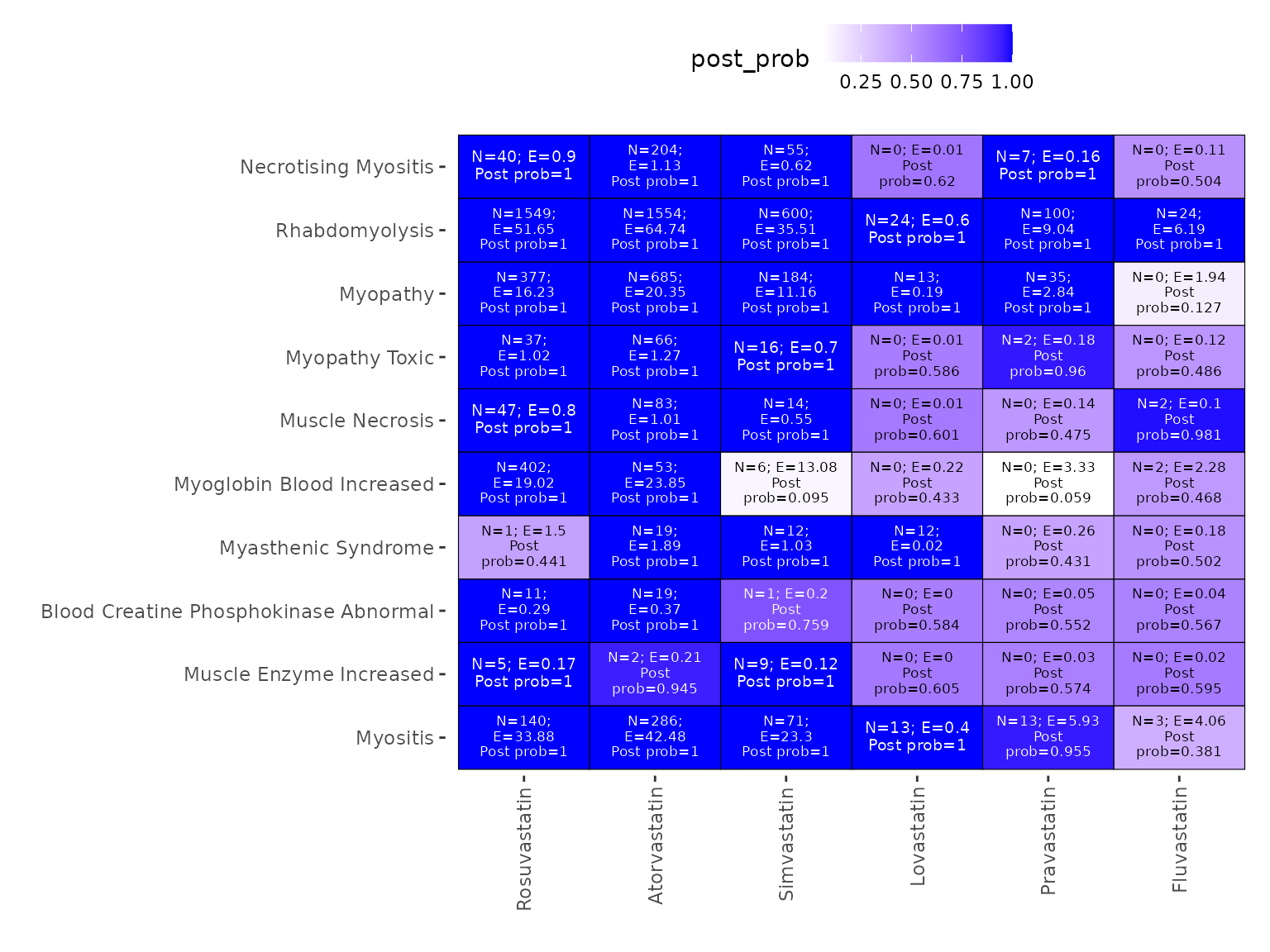
The above heatmap visualizes the signal detection result for the fitted general-gamma model. For each AE-drug combination, the number of reports (N), the estimated null value (E), and the estimated empirical Bayes posterior probability of being a signal are given. A deeper blue color indicates stronger evidence for a signal.
eyeplot_gg_tune_statin44 <- plot(gg_tune_statin44,
  type = "eyeplot",
  num_top_AEs = 8,
  N_threshold = 1,
  log_scale = FALSE,
  text_shift = 2.3,
  text_size = 3,
  x_lim_scalar = 1.2
)

eyeplot_gg_tune_statin44 +
  theme(
    legend.position = "top"
  )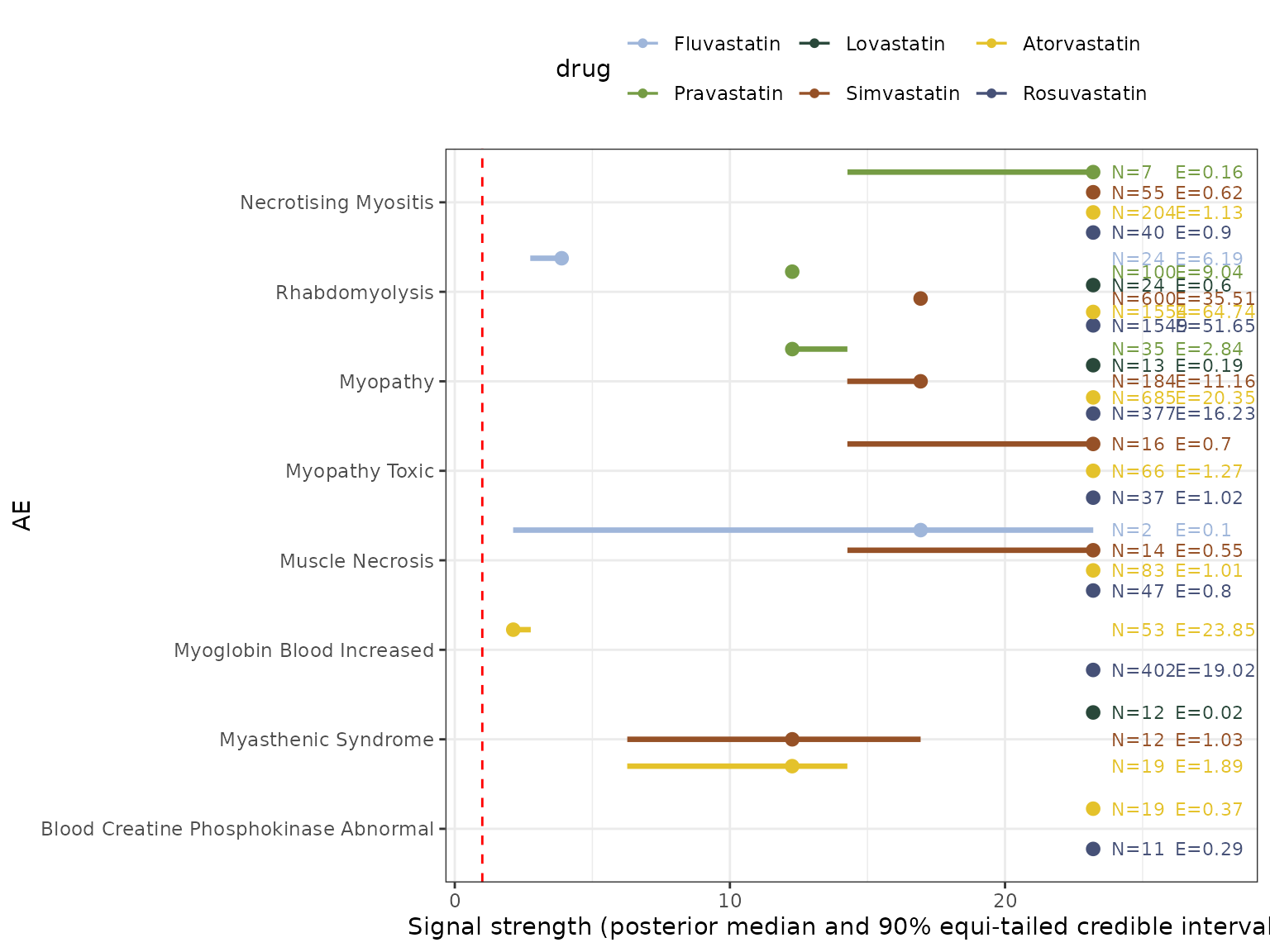
The above eyeplot visualizes empirical posterior inferences on 10 prominent AEs across 6 statin drugs through computed empirical Bayesian posterior distributions of signal strengths obtained from the general-gamma model fitted on the statin2025_44 dataset. The points and bars represent the posterior medians and 90% equi-tailed credible intervals for the corresponding AE-drug pair specific , with different colors indicating the results from different statin drugs. The red dotted vertical line represents the value ‘1’. The texts on the right provide the number of observations as well as the null baseline expected counts under independence for an AE-drug pair.
References
Tan Y, Markatou M and Chakraborty S. Flexible Empirical Bayesian Approaches to Pharmacovigilance for Simultaneous Signal Detection and Signal Strength Estimation in Spontaneous Reporting Systems Data. Statistics in Medicine. 2025; 44: 18-19, https://doi.org/10.1002/sim.70195.
Tan Y, Markatou M and Chakraborty S. pvEBayes: An R Package for Empirical Bayes Methods in Pharmacovigilance. arXiv:2512.01057 (stat.AP). https://doi.org/10.48550/arXiv.2512.01057
Tan Y, Markatou M, Chakraborty S. A Review of Statistical Methods for Spontaneous Reporting System Data Mining: Signal Detection and Beyond. arXiv:2604.18898 (stat.AP). https://doi.org/10.48550/arXiv.2604.18898
Koenker R, Mizera I. Convex Optimization, Shape Constraints, Compound Decisions, and Empirical Bayes Rules. Journal of the American Statistical Association 2014; 109(506): 674–685, https://doi.org/10.1080/01621459.2013.869224
Efron B. Empirical Bayes Deconvolution Estimates. Biometrika 2016; 103(1); 1-20, https://doi.org/10.1093/biomet/asv068
DuMouchel W. Bayesian data mining in large frequency tables, with an application to the FDA spontaneous reporting system. The American Statistician. 1999; 1;53(3):177-90.